

Table of Contents
This article is a retrospective analysis of the Luxembourg real estate market 2025, written at the close of the year and updated in early 2026. It draws on transaction data, price indices, and policy changes through December 2025 to provide a documented reference point for what the market went through — and what the structural conditions entering 2026 look like. For current market conditions and active guidance, get in touch directly.
The Luxembourg real estate market 2025 completed a full recovery cycle in a single year. After five consecutive quarters of price decline through 2023 and into 2024, transaction volumes surged 49% in 2024, prices stabilised at €8,670/m² by Q2 2025, and buyer confidence returned — supported by falling interest rates and a permanent change to the Bëllegen Akt homeownership credit. At the same time, construction output continued to fall, setting up a supply constraint that will shape the market well into the decade.
Luxembourg Real Estate Market 2025: How the Recovery Unfolded
Understanding the Luxembourg real estate market 2025 requires context from the correction that preceded it. Between 2010 and 2022, the market posted sustained annual price growth — averaging 5.7% per year from 2010 to 2017, then accelerating sharply to 7.1% in 2018, 10.1% in 2019, and 14.5% in 2020. This growth was structural: demand driven by demographic and economic expansion consistently outpaced new housing supply.
The correction began in 2022 as rising interest rates, inflation, and geopolitical uncertainty combined to suppress buyer activity. In Q1 2023, the market recorded a 1.5% drop versus the same period in 2022 — the first meaningful decline since 2009. The fall was uneven by property type: existing apartments held relatively firm at +0.4%, while existing houses fell 4.3% and off-plan sales (Vente en l’État Futur d’Achèvement, or VEFA) dropped 0.4%.
The decline deepened in Q2 2023, with existing houses falling 13.5% year-on-year — a correction that reflected both the rate environment and the reset of buyer expectations after a decade of exceptional growth. Only new apartments showed any resilience, with a modest 2.2% gain after two negative quarters.
By 2024, the conditions driving the correction had begun to ease. Interest rates fell, inflation moderated, and buyer confidence gradually returned. Transaction volumes surged 49% in 2024 compared to 2023, according to data from the Observatoire de l’Habitat — a signal that the market had absorbed the correction and buyers were re-engaging at scale. By Q2 2025, average sale prices had stabilised at €8,670/m², up 1.9% quarter-on-quarter though still 1.5% below the same period in 2024, indicating a market finding its floor rather than resuming the pre-2022 trajectory.
Luxembourg Real Estate Market 2025: Price Structure by Region and Energy Class
The Luxembourg real estate market 2025 showed significant price variation by geography and by energy performance class — two variables that increasingly move together as buyers price in running costs and future regulatory risk.
The national average of €8,670/m² masked meaningful regional spread. The Centre region — covering Luxembourg City and its immediate surrounds — commanded the highest premiums, while the North offered the most affordable entry points. The premium for high-efficiency properties (energy classes A–C) over low-efficiency stock (classes F–G) varied by region: approximately €1,358/m² in the Centre, €1,112/m² in the South, €958/m² in the West, €938/m² in the East, and €743/m² in the North.
Energy class has shifted from being a sustainability consideration to a direct pricing variable in the Luxembourg real estate market 2025. Sixty-five per cent of new listings carried Class A energy ratings by the close of 2025, reflecting both the AAA construction standard mandatory since 2017 and growing seller awareness that energy class affects saleability. For buyers, the practical implication is that lower-rated properties — classes E through I — carry a measurable price discount that partly reflects expected upgrade costs and partly reflects weaker future demand as minimum efficiency standards tighten under EU directives.
For an explanation of how energy performance certificates are assessed and what different classes mean in practice, our article on the energy performance certificate in Luxembourg covers the process in full.
Policy Changes That Shaped the Luxembourg Real Estate Market 2025
Two significant policy changes took effect in mid-2025 that materially altered the cost structure of buying in the Luxembourg real estate market 2025.
Registration fees returned to 7%. The temporary 50% reduction — which had lowered the standard 7% registration fee to 3.5% — expired on 30 June 2025. From 1 July 2025, all property acquisitions are subject to the full 7% rate. For a €900,000 purchase, the difference between the two rates is €31,500 in additional acquisition cost — a meaningful change that brought forward a number of transactions into H1 2025 as buyers sought to complete before the deadline.
The Bëllegen Akt was made permanent. The registration duty credit of €40,000 per person (€80,000 for jointly taxed couples) for primary residence purchases was confirmed as a permanent feature of the Luxembourg tax framework, effective 1 July 2025, per Administration de l’Enregistrement, des Domaines et de la TVA (AED) guidance. For a couple purchasing a primary residence, the €80,000 credit offsets the majority of the 7% registration fee on a property up to approximately €1.14 million — reducing what would otherwise be an €80,000 registration bill to a nominal minimum. The permanence of this credit removes the time pressure that previously prompted buyers to rush decisions ahead of expiry dates.
Investor-specific incentives ended. The Bëllegen Akt Investisseurs — a €20,000 per person credit for off-plan rental property purchases — ended on 30 June 2025. The 6% VEFA special construction allowance for rental properties ended on 30 September 2025. Neither has been replaced. The Luxembourg real estate market 2025 therefore closed with a cleaner, simpler incentive structure: strong primary residence support through the permanent Bëllegen Akt, and standard depreciation rules (2% annual, 4% accelerated for properties under five years old) for investors. Our article on tax optimisation for Luxembourg property covers the current investor framework in full.
Supply: The Structural Challenge Facing the Luxembourg Real Estate Market 2025 and Beyond
The most consequential underlying dynamic in the Luxembourg real estate market 2025 is one that received less attention than the transaction volume surge or the policy changes: the sharp contraction in new housing supply.
Construction output has nearly halved since 2021. A market that requires an estimated 5,600 to 7,500 new housing units per year to keep pace with demographic growth — according to government housing projections — was producing substantially fewer than that by 2025. The causes are layered: higher financing costs for developers, increased construction material costs, planning delays, and a land market where 89% of buildable land remains in private ownership, limiting public intervention in supply-side solutions.
Luxembourg’s available buildable land stands at approximately 793 hectares for housing. Land prices increased at an average of 8.5% annually between 2010 and 2022 — a cumulative increase of over 150% — before moderating slightly in the correction period. The structural pressure on land costs has not reversed.
The market trend toward apartment construction over individual houses has accelerated through this period. Between 2010 and 2016, apartments represented 60% of new housing units built. By 2025, that proportion had grown further — a pattern driven partly by land scarcity and partly by densification policy. For buyers weighing the relative merits of older houses versus newer apartments, our article on old versus new property in Luxembourg covers how the financial and practical trade-offs play out.
The Rental Market in the Luxembourg Real Estate Market 2025
The rental segment of the Luxembourg real estate market 2025 followed a different trajectory from the sales market. Between 2010 and 2022, apartment rents rose an average of 4% per year — a cumulative 53.2% increase over twelve years. House rents increased at 3.2% annually over the same period, a cumulative 41.4% rise.
After strong increases in 2023 and early 2024, the rental market showed signs of rebalancing in late 2024 and through 2025. Tenants in the private market continued to face affordability pressure, with some households spending 37–40% of income on rent — well above the 30% threshold generally considered sustainable. The rental law reforms effective August 2024 introduced new tenant protections that are now fully embedded in the market.
For landlords and investors considering the Hesperange rental market specifically, our articles on rental prices in Hesperange and rental yield in Hesperange provide sub-commune level data that the national figures do not capture.
What the Luxembourg Real Estate Market 2025 Means for Buyers in 2026
Reading the Luxembourg real estate market 2025 data as context for 2026, several structural conditions are clear.
Demand is structurally supported. Luxembourg’s population growth — driven by a workforce from over 195 nationalities — continues to generate housing need that new construction is not meeting. The 49% transaction volume surge in 2024 absorbed significant inventory. Combined with halved construction output, this points toward continued supply tightness, particularly in well-connected, family-oriented communes.
The permanent Bëllegen Akt removes a recurring source of market distortion. Previously, each scheduled expiry of the credit brought forward transactions and created artificial peaks and troughs in activity. With the credit now permanent, buyer decisions can be made on fundamentals rather than deadline pressure.
Energy class is now a financial variable, not just a preference. The €1,358/m² premium for high-efficiency stock in the Centre region is not decorative — it reflects real running cost differentials and anticipates regulatory pressure on lower-rated buildings. Buyers who acquire Class E or F properties at a discount need to factor in the likely cost of upgrades and the trajectory of that discount over the holding period. Our article on renovation support in Luxembourg covers what subsidy programmes are available to offset those costs.
The Luxembourg real estate market 2025 also confirmed that the correction of 2022–2023 was a reset rather than a structural reversal. Prices stabilised, not collapsed. Transaction volumes recovered sharply. The fundamentals — demographic growth, land scarcity, economic resilience — that drove the pre-2022 run have not changed. What has changed is the rate environment and buyer expectations: the era of 14% annual price growth is behind us, but the underlying demand case for Luxembourg property remains intact.
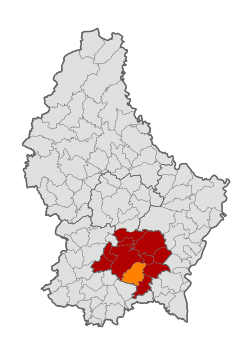
If you are considering a purchase in Hesperange commune — whether in Howald, Alzingen, Itzig, Fentange, or Hesperange village — and want to understand what the Luxembourg real estate market 2025 data means for your specific search, we are glad to walk through it with you. We represent buyers exclusively, and our approach is grounded in transaction data, not asking prices.
Get in touch with us here to discuss your search, or use our property cost calculator to start modelling acquisition costs independently.


 English
 Français
 Deutsch
 Luxembourgish
Join The Discussion